Fantasy Football Breakouts: Christian Watson Leads Trio with League-Winning Upside
You Might Be Looking at These Guys Wrong
What makes a player a Breakout candidate rather than just one of our Sleepers?
There’s no definitive line, of course, but here’s how I view the separation …
Sleepers are merely guys going later than the should, players we expect to deliver more value than the position at which they’re being drafted. A Breakout? He can define your season.
A fantasy football breakout candidate is on the verge of delivering production beyond anything we’ve seen from him to date. And if he delivers on that potential, you’ll remember him for years as one of your championship drivers.
Here are three guys who look ready for you to toss them the keys …
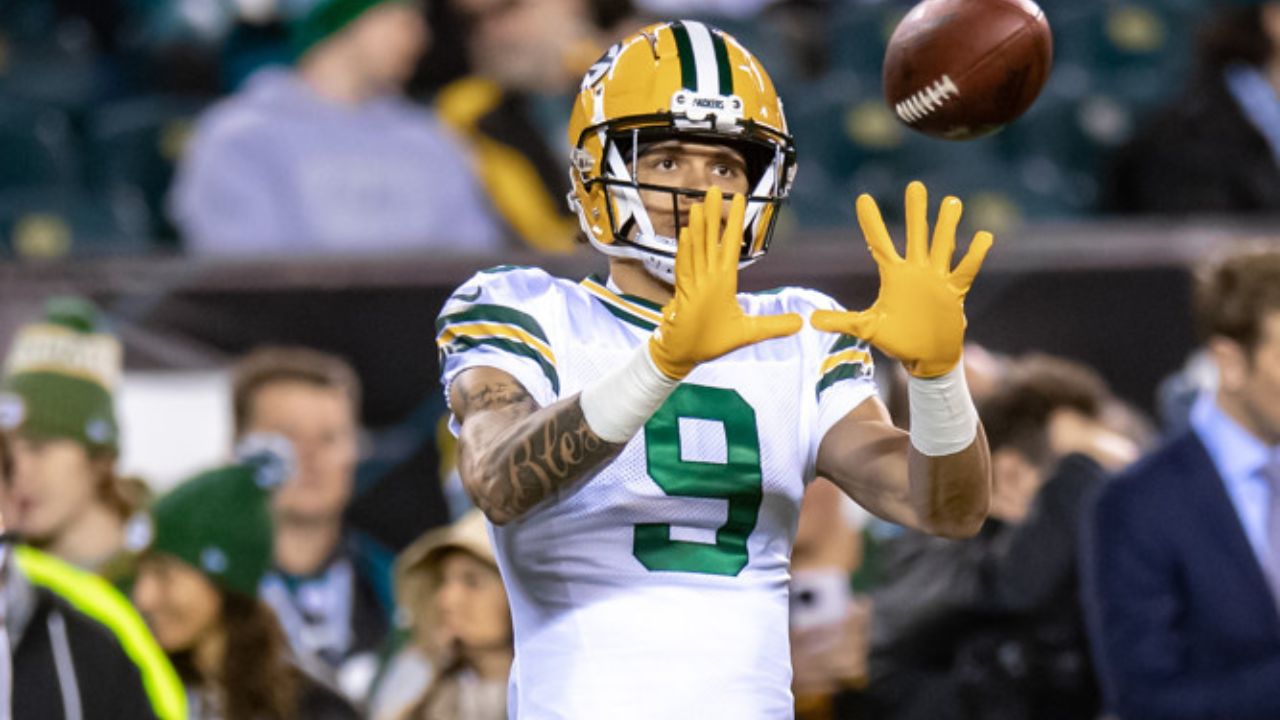
Christian Watson, WR, Green Bay Packers
I can hear you groaning at this first name, and I get it. Jared nominated this guy, and I wasn’t sure I was on board. I’m honestly not even sure I’m comfy with his spot in our fantasy football rankings.
But why this fifth-year player elicits such reactions is key to understanding why he fits in this list.
Try to Work Past Your Injury Aversion
What do we all hate about Watson? The durability, of course. Or the lack of it, to be more precise.
Watson has appeared in just 48 of a possible 68 regular-season games across his four NFL seasons. He has missed 7+ contests in two of the past three seasons. And the season between ended with a Jan. 5 ACL tear.
But it was that injury that cost Watson the first seven games of last season. Once he returned to the field, he stayed there. He did pop back up on the injury reports for weeks 16 (chest) and 17 (shoulder) but played through questionable tags each time.
For the first time since he entered the league, Watson didn’t suffer any in-season lower-body injury. And he performed better than you probably realize he did.
Chase the Enhanced Efficiency
Watson’s age-26 season found him quietly leading all Packers WRs in targets per route and yards per route. The first category found him ranking 24th among the 76 WRs who drew at least 50 targets last season. The latter found him fifth, trailing only …
- Puka Nacua
- Jaxon Smith-Njigba
- Luther Burden
- Zay Flowers
… and just ahead of Amon-Ra St. Brown.
Watson’s 2.51 yards per route, according to Pro Football Focus, was a career high. But he had already shown well in that area.
Watson tied for 14th in that category in 2024, among 84 WRs with 50+ targets. And his 2022 rookie campaign found him 11th among the 80-WR cohort.
The 0.218 targets per route Watson posted last season marked a bump from his previous two years -- 0.188 and 0.186 -- but he fared even better in that category as a rookie. Watson’s 0.241 targets per route ranked 12th among 50+ target WRs that season. Check out the full top 12:
- Tyreek Hill
- Amon-Ra St. Brown
- Cooper Kupp
- Drake London
- Davante Adams
- Chris Olave
- CeeDee Lamb
- DeAndre Hopkins
- Justin Jefferson
- Stefon Diggs
- DK Metcalf
- Watson
Pretty good club if you can get in.
Why So Much Focus on Targets and Yards Per Route?
Here’s why those efficiency metrics matter:
- A high rate of targets per route indicates the team is purposely trying to get the ball to that player, especially relative to his teammates.
- A strong performance in yards per route tells us both that he’s getting opportunities and that he’s turning them into yards.
Yards per reception presents more limited data on a WR’s performance. And even looking at yards per target still leaves out how often he’s actually drawing targets.
Watson’s young career, though -- all under HC Matt LaFleur -- has showed us that the Packers want to get him the ball when he’s on the field and that he’s capable of delivering yardage and TDs when he gets the ball.
Since his 2022 rookie season, 129 WRs have garnered at least 100 total targets. Watson’s 15% TD rate over that span ranks third among that group, trailing only Jalen Nailor and Nick Westbrook-Ikhine.
And the big ol' contract extension the Packers gave Watson at the beginning of June shows they believe he's capable of even more.
If He Can Stay Healthy …
Let’s not forget that those team leading rate stats from last season came after Watson missed the first half of the year. He returned to a team that had drafted a WR in Round 1, still had Romeo Doubs, and got Jayden Reed back from injury in Week 14.
Doubs is gone. We have our doubts about Matthew Golden ever developing into a corps leader. Reed’s still around, but Watson has beaten him 124-112 in targets over their shared, healthy 25 regular-season games to date. And TE Tucker Kraft’s coming off an ACL tear.
Watson, meanwhile, will be more than a year and a half beyond his own ACL tear when this season begins. He’ll be more than two years removed from the last time a hamstring injury landed him on the injury report (January 14, 2024). He’ll be entering his age-27 campaign, prime time for WRs. And he’ll be playing with a head coach and QB who have been in Green Bay for Watson’s entire career.
And he’ll be featured in a Packers offense that has finished three straight years among the league’s top 6 in DVOA (defense-adjusted value over average).
Oh, and that injury history that made you groan back at the beginning? They have the market drafting Watson just 28th among WRs so far. So you don’t have to pay too much to get on board ahead of the breakout.
Bottom Line
Watson brings talent, situation, usage, and career efficiency that you can trust. The big question is health. But he has avoided hamstring issues the past two years and still presents an ADP discount for that risk. He’s well worth chasing at cost.
Colston Loveland, TE, Chicago Bears
This guy didn’t make our original fantasy football breakouts list, but he probably should have.
I hesitated because his TE3 ADP seemed a little too high to call him a draft target back in early spring. But the further we get into drafting season, the more I disagree with my initial stance.
In fact, I now think the young guy might even be a little … underrated.
Is This Chicago’s New Lead Receiver?
Before we get to Loveland’s market valuation, it’s important to lay out what makes the player attractive. And the sexiest aspect has to be that the breakout already started.
The first-round pick spent most of his rookie season navigating fluctuations in playing time. That included a peak of two straight games at 81% playing time and a stellar 6-118-2 receiving line in Week 9 at Cincinnati. But Loveland played just 60.4% of Bears offensive snaps through Week 15, while averaging a mere 4.2 targets, 3.0 catches, and 38.3 yards per game.
But then came four straight games of more than 80% playing time (including the playoff win at Green Bay) and four straight games of 10+ targets (including both playoff contests).
From Week 17 through the playoffs, here’s how he aligned with Chicago’s other top two pass catchers over the same span:
| Player | Route% | aDOT | Air Yds% | Tgts | Share | Tgts/Rte | Rec | Yds | YPRR |
| Loveland | 75.4% | 10.6 | 35.5% | 47 | 28.5% | 0.35 | 28 | 378 | 2.80 |
| Luther Burden | 60.3% | 9.0 | 16.1% | 25 | 15.2% | 0.23 | 17 | 239 | 2.21 |
| D.J. Moore | 79.3% | 9.4 | 14.7% | 22 | 13.3% | 0.15 | 13 | 134 | 0.94 |
(WR Rome Odunze played just two of those four games while dealing with a foot injury.)
Loveland racked up 69 more receiving yards than any other player in the league over that stretch, despite a meh 59.6% catch rate.
Maybe Just a Small Sample … or Maybe a Preview
It can be dangerous to take any four-game (or similar) sample and build your player expectations out of it, and we’re certainly not extrapolating Loveland’s four-game finish into a full 2026 projection. That’d produce a monstrous stat line of:
- 204 targets
- 119 catches
- 1607 yards
- 8.5 TDs
- 20.5 PPR points per game
That would be the position’s third-best fantasy season of all time, trailing only Travis Kelce’s 2020 and Rob Gronkowski’s 2011 (by PPR points per game).
But that small sample did find a guy Chicago drafted 10th overall ascending to a lead position in the passing game and dominating teammates in both opportunity and production.
Loveland absolutely can replicate those aspects.
The Prospect Profile Was Stellar
The high draft capital obviously matters, but it’s important to remember that Loveland’s appeal didn’t start that day.
He broke out as a 19-year-old sophomore at Michigan, posting a 45-649-4 receiving line in an offense that sent WR Roman Wilson, WR Cornelius Johnson, TE AJ Barner, and RB Blake Corum into the draft following that season.
Loveland then dominated the offense after that crew and QB J.J. McCarthy left, more than doubling his nearest teammates in receptions (56), receiving yards (582), and TD catches (5) despite missing three games. His 49.6% dominator rating (share of team receiving yards plus TDs) rated in the 100th percentile historically among TEs, according to PlayerProfiler.
NFL Network’s Ian Rapoport said after the 2025 draft that teams appeared to be trying to trade up into the top 10 to get Loveland.
“No one’s ever going to tell you who they’re trying to trade up for,” Rapoport said on the Pat McAfee Show). “The only thing I can tell is like when the calls stop … The Bears take Colston Loveland at 10, and a bunch of calls stopped. … We all thought Tyler Warren was the dude, but it seems like Loveland was kind of the dude.”
(Warren went four picks later.)
Here’s How You Can Be Underrated at TE3
It’s certainly fair to keep the second-year TE behind Brock Bowers and Trey McBride in positional ADP. But Loveland’s going nearly two rounds behind that lead duo in Underdog Fantasy ADP so far. And that has made him a tremendously better value by our market index.
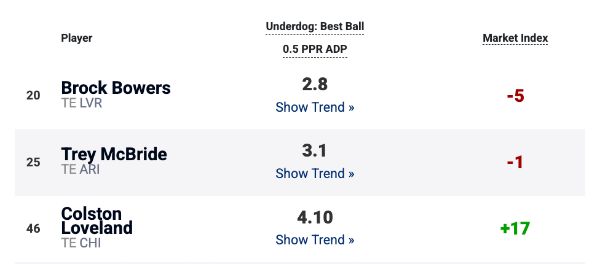
Drafting Bowers requires a Round 2 pick, and McBride’s barely into Round 3. But waiting for Loveland in Round 4 means you can draft three other high-level players and still land a TE with a similar ceiling.
And that’s what we learned with the late-2025 production spike. We don’t have to guess whether Loveland’s ceiling climbs that high. He showed us it does.
Bottom Line
Loveland’s TE3 ADP shows that the draft market is already excited about his Year 2 breakout potential, but even that high price doesn’t totally capture his upside. Loveland’s our first touchstone in this year’s TE draft plan and one of my most drafted players at the position so far in best ball tournaments.
Jared and I Agreed on Loveland as a Key Draft Target in This Recent Podcast
Ricky Pearsall, WR, San Francisco 49ers
We listed this guy among our fantasy football breakout picks last year, with this summary:
The 49ers showed how much they like Pearsall by drafting him in Round 1 [in 2024]. Now he's healthy in an offense struggling with the health of WRs around him. And he sits just WR45 in PPR ADP. Good luck finding a reason not to draft this guy.
He didn’t work out for you. But that’s not because he didn’t play well. The problem was that Pearsall didn’t play enough.
He’s Not Injury Prone; That’s Your Recency Bias
Pearsall lost eight games of his second NFL season, primarily to a PCL sprain. That knee injury knocked him out of Week 4 early, sidelined him until Week 11, and then popped back up with a late-season aggravation (plus a low-ankle sprain).
But the second injury round proved far less significant. Pearsall missed Week 16, Week 18, and the playoff win at Philly. But he returned for the divisional-round loss at Seattle and played in Week 17.
Pair his nine-game second season with an 11-game debut, though, and Pearsall might seem like a problem. But remember that he missed the first six games of that season because of a late-August gunshot wound.
I guess it’s a little too early in his career to say whether he’s gunshot prone, but I’ll go ahead and bet on that not becoming a regular risk factor. And Pearsall brought no injury flags from college. He missed zero of 55 career games across five seasons split between Arizona State and Florida.
So if you’re scared to draft him right now because of injury concern, you’re simply looking at the situation wrong.
TIP
Chasing upside is part of the best way to draft fantasy football.
Pearsall Has Flashed When Healthy
Despite getting the middle of his 2025 ripped out by a knee injury, Pearsall still managed a solid No. 25 ranking last year in yards per route, among 76 WRs who drew at least 50 targets.
Pearsall opened the year with 108+ yards in two of his first three games (before leaving the fourth early), and his final two regular-season contests produced 6-96 and 5-85 receiving lines.
There were rougher outings in between -- including three straight games of two catches or fewer after his return from the knee injury -- and the overall fantasy numbers weren’t good. Pearsall ranked 48th among WRs in PPR points per game, thanks in part to zero TDs all season. Even his expected PPR points per game tied for just 46th.
That means he’s certainly no lock for 2026 production. But the modest performance (and missed time) is also suppressing his draft cost. Pearsall sits a mere 40th among WRs in best ball ADP, despite a path to enhanced usage.
Did His Situation Improve for 2026?
What we don’t yet know is how high Pearsall can climb in the team target distribution. We just haven’t seen enough healthy Pearsall to see it yet. But there might be more opportunity available in San Francisco than you’d think.
Yes, the 49ers signed Mike Evans. He’s clearly better than Jauan Jennings, who ranked second on the team in targets and receiving yards last year, led the team in TD catches, and is now a Viking. But Evans turns 33 in August and has missed 12 games over the past two seasons, with a hamstring issue in each. That profile brings significant risk when you project future missed time.
The Athletic's Vic Tafur says, "Shanahan swears by Pearsall's upside, and one of the underrated aspects of Evans' arrival is how well he and Pearsall fit together scheme-wise."
The Niners also return RB Christian McCaffrey and TE George Kittle, the other two members of last year’s top three in receiving. But Kittle is coming off a January Achilles’ tear and could miss the start of the season.
McCaffrey didn’t miss a game last year while racking up a career-high 311 carries and the most catches (102) since his third season (2019). Sheer luck makes him unlikely to match that usage. Check his career, for example, and you’ll see that McCaffrey hasn’t played more than 11 games in consecutive seasons since 2019.
San Francisco also signed WR Christian Kirk. But he arrives on just a one-year, $6 million deal following a career-low 2.2 catches per game in his lone Houston season. If a healthy Pearsall trails Kirk in production, it’ll be time to stop believing there’s upside here.
Expect More Work for Niners WRs
Even if Kirk and Evans stay healthy and involved, we can expect significantly more total targets to head toward wide receivers in San Francisco.
Last year’s squad sent just 43.6% of targets toward WRs. That marked the lowest share among HC Kyle Shanahan’s nine seasons at the helm, by a significant margin.
| Year | WR Share |
| 2025 | 43.6% |
| 2024 | 54.4% |
| 2023 | 53.8% |
| 2022 | 51.6% |
| 2021 | 56.8% |
| 2020 | 49.3% |
| 2019 | 48.7% |
| 2018 | 48.7% |
| 2017 | 54.5% |
| AVG | 51.3% |
San Francisco might also throw less overall. The Niners ranked 10th in pass attempts last year, 12 spots higher than in any of the previous four seasons. But Shanahan’s offense has lived near the top of the league in efficiency. Here are the annual ranks in yards and TDs relative to pass attempts.
| Year | Att | Yards | TDs |
| 2017 | second | ninth | 28th |
| 2018 | 20th | 15th | 17th |
| 2019 | 29th | 13th | 10th |
| 2020 | 16th | 12th | 19th |
| 2021 | 29th | 12th | 14th |
| 2022 | 26th | 13th | fourth |
| 2023 | 32nd | fourth | second |
| 2024 | 22nd | fourth | 13th |
| 2025 | 10th | fifth | fourth |
QB Brock Purdy took over midway through 2022, and you can see the passing-game improvement since.
Bottom Line
Pearsall remains a fairly unknown pro entity. But he plays in the league’s most consistently efficient passing offense, with a path to easy role growth, and a coach who selected him in Round 1. At a mid-WR4 cost, he presents far more upside than risk.
Now It's Time to Draft These Guys
We've made the cases for three potential breakout fantasy stars. But when should you target them in your specific draft? There's only one way to find out.
Use the League Sync to import all your draft settings to Draft Sharks. That will generate your Draft War Room, the only tool you need to embarrass your league mates on draft day.
You could draft without it. But why stop when you're this close to such a game changer?
Learn More About the Draft War Room